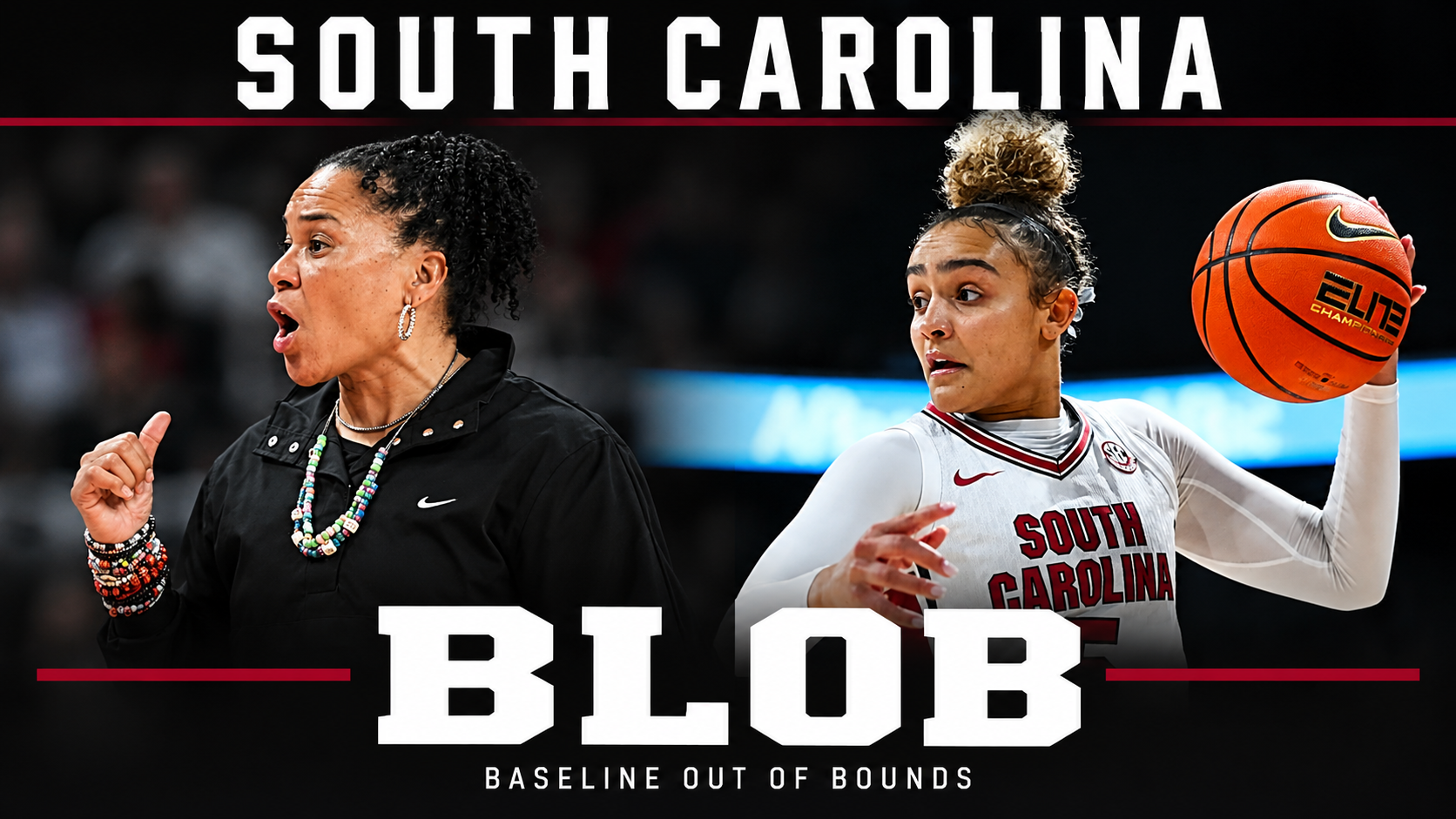
The South Carolina Gamecocks, under head coach Dawn Staley, have become a modern-day powerhouse in women’s basketball. Three national championships and multiple trips to the Final Four speak for themselves.
A look inside the Gamecocks’ playbook, particularly their baseline out-of-bounds (BLOB) sets, reveals a clear offensive philosophy: put the ball in the hands of your best players and create opportunities for them to use their strengths.
These examples feature Tessa Johnson, a sharp-shooting guard whose skill set is central to Staley’s play designs. The Gamecocks use specific BLOB actions to create scoring opportunities that take advantage of her shooting ability.
BLOB: Box Screen-The-Screener (STS)
BLOB selection isn’t always about finding the trickiest play or introducing something new. It’s about timing, execution and personnel placement.
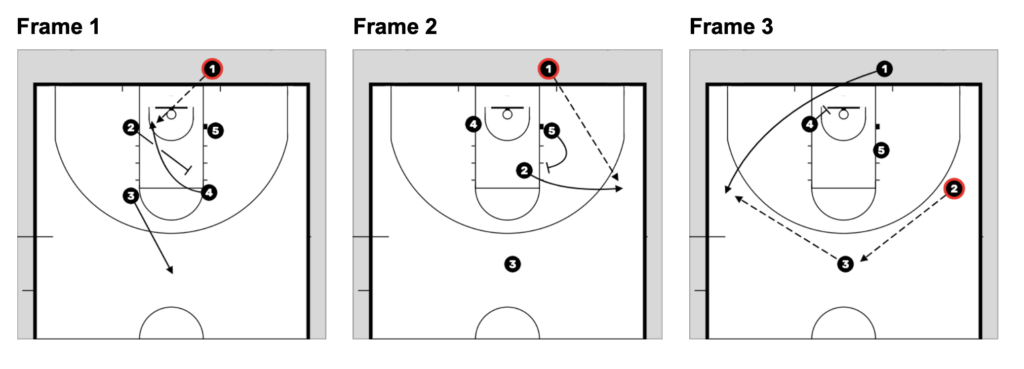
This example begins in a box alignment, with Johnson positioned as Player 2. Using a good shooter as a screener can be effective because defenders are reluctant to leave that player to help on a cutter. Player 2 initiates the action by setting a diagonal back screen for Player 4, who cuts to the rim for the first scoring option (Frame 1).
Free Trial: Get access to FastBreak Playbook
The second option comes from screening for the screener. Player 5 takes a wide, arcing path before setting a screen for Player 2. After defending the initial back screen, Player 2’s defender must immediately navigate another screen. That sequence can create an open look for the team’s best shooter (Frame 2).
Finally, after the ball is entered to Player 2, the Gamecocks can reverse it to Player 3, who looks for Player 1 cutting into the court off a screen from Player 4.
Execution Tips:
- Begin the action as soon as the official administers the ball to the inbounder.
- Align your bigs on the same side as the ball.
- The better the first screen, the more effective the second screen will be.
- Player 5 must take a wide, arcing path to adjust the angle of the screen and pin Player 2’s defender in the lane.
BLOB: Elevator Set
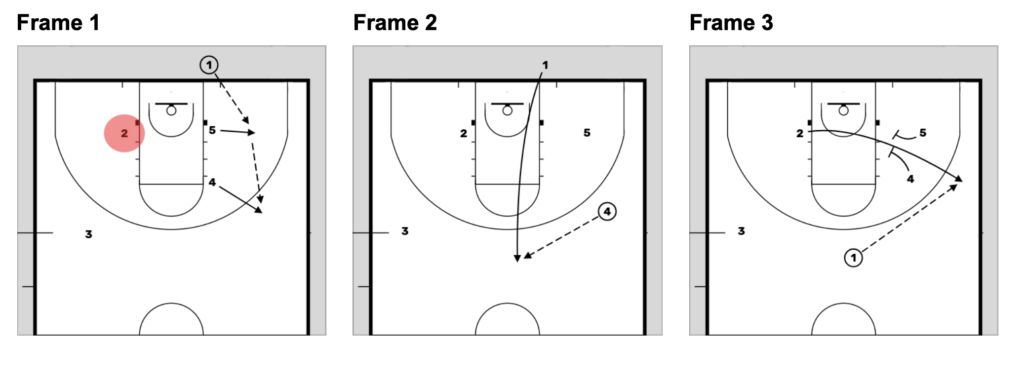
Another example of how the Gamecocks use Johnson’s shooting ability is this elevator set. Johnson is once again designated as Player 2 in the diagram.
Player 5 uses a cutoff step before popping off the lane line to receive the entry pass. Player 5 then delivers the ball to Player 4, who pops out to receive the pass.
After inbounding the ball, Player 1 sprints up the middle of the floor. As Player 4 passes to Player 1, Player 2 sprints through the screens set by Players 4 and 5, catching the defense as the elevator doors close.
Conclusion
South Carolina’s success under Dawn Staley is built on a clear understanding of personnel and the details of execution. These BLOB examples show how that philosophy carries over to special situations. The plays aren’t particularly complicated, but their effectiveness depends on precise timing, quality screens and players understanding their responsibilities.
Staley also puts her players in positions to succeed. By designing actions that take advantage of Johnson’s shooting ability, South Carolina creates opportunities for its best perimeter threat. The Gamecocks’ approach is a reminder that an effective BLOB package doesn’t require a collection of elaborate designs. It requires a coach who understands her personnel and players who can execute when the opportunity comes.