There are two things students of the game of basketball can count on. First, UConn women’s basketball will field a championship-caliber team. Second, teams at all levels will rely on some variation of the Princeton Offense.
Those two things come together here as we break down UConn’s use of Chin Sets within the Princeton Offense.
Princeton Offense: Chin Set
“Chin” is arguably the most recognizable action in the Princeton Offense. Its basic actions and variations are used throughout the basketball world. UConn provides textbook examples of how to execute them.
Free Trial: Get access to FastBreak Playbook
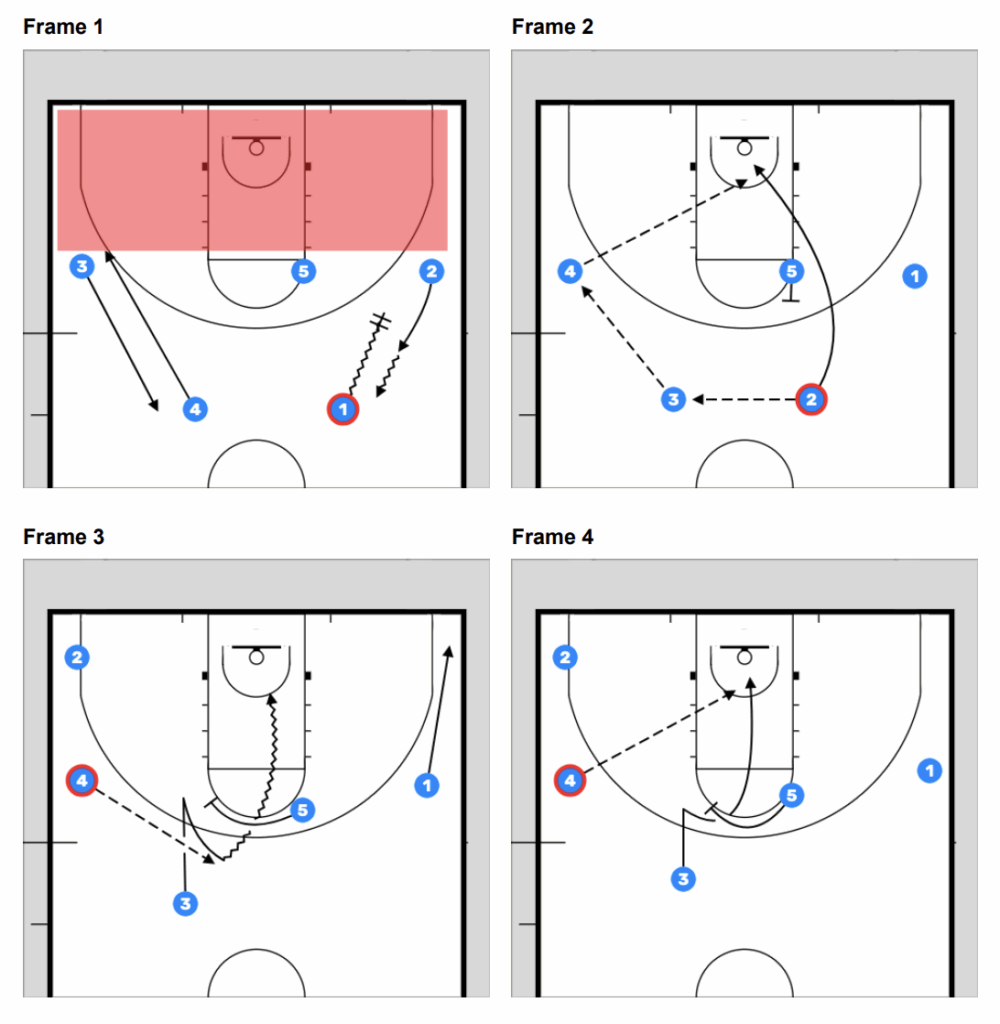
Above (Fig. 1), we see an illustration of the concept of “lifting the defense.” In Frame 1, all five players are positioned above the free-throw line, drawing defenders away from the basket. This is vital because, in the Chin Set, players will be cutting into that space.
UConn uses the “Forwards Out” entry to initiate Chin. This entry features a dribble handoff on one side and an exchange on the other.
In Frame 2, we see the first signature action of Chin: the “Chin cut” off a back screen. The ball is reversed to the forward position (Player 4), and Player 2 cuts off a back screen set by Player 5. If the back screen does not create a scoring opportunity, Player 2 continues to the ball-side corner.
In Frame 3, we see the second signature action of the Chin Set: the drift screen.
Player 3 moves toward the elbow to set up the screen. After setting the back screen, Player 5 follows the natural curve of the 3-point line and sets a screen for Player 3, who pops back out.
Player 3 can either receive a pass back from Player 4 or curl around the screen to create another scoring threat at the rim.
UConn often resets and runs “Chin Again,” cycling through the actions a second time.
Below (Fig. 2), let’s assume Player 3 uses the drift screen and curls around it but does not receive the ball. Player 3 continues the cut to the far corner, bringing the offense to a reset position. From here, teams can flow into other phases of the Princeton Offense, but UConn often elects to run “Chin Again.”
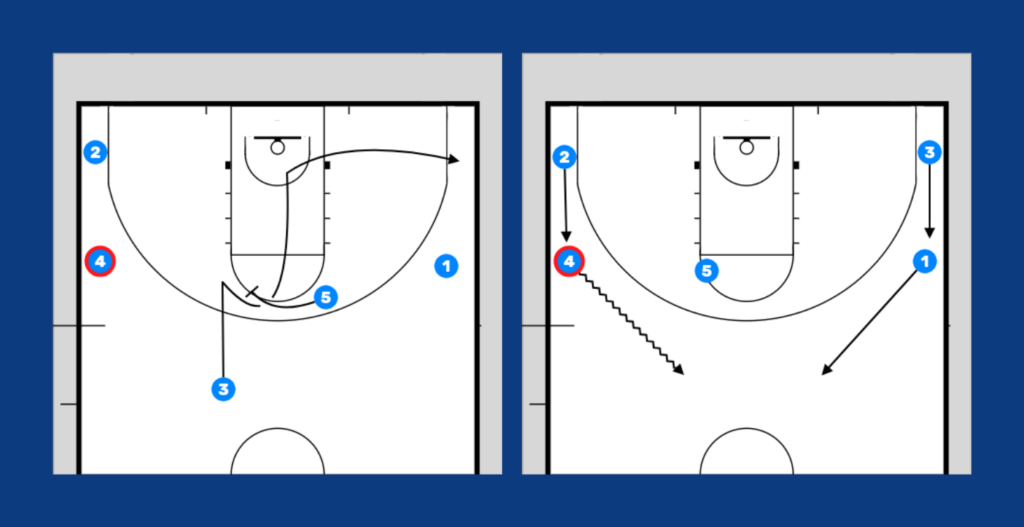
Player 4 dribbles up to a guard spot, while Player 1 moves to the opposite guard spot. I call this process “squaring the top.” Players 2 and 3 rise out of the corners to once again lift the defense.
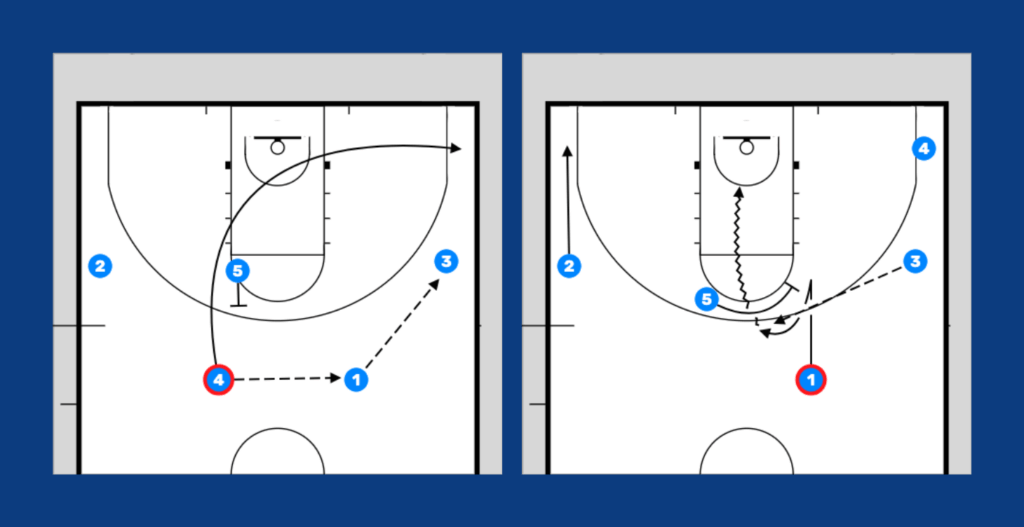
The offense can now repeat the Chin actions. As the ball is reversed, Player 5 sets a back screen for Player 4, then follows the arc of the 3-point line to set the drift screen for Player 1.
Princeton Offense: Chin Flare
Another weapon in UConn’s arsenal is a collection of set plays that stem from the Chin Set. Whether the Huskies want to create a shot for a specific player or find themselves in a “need a three” situation, they can turn to Chin variations.
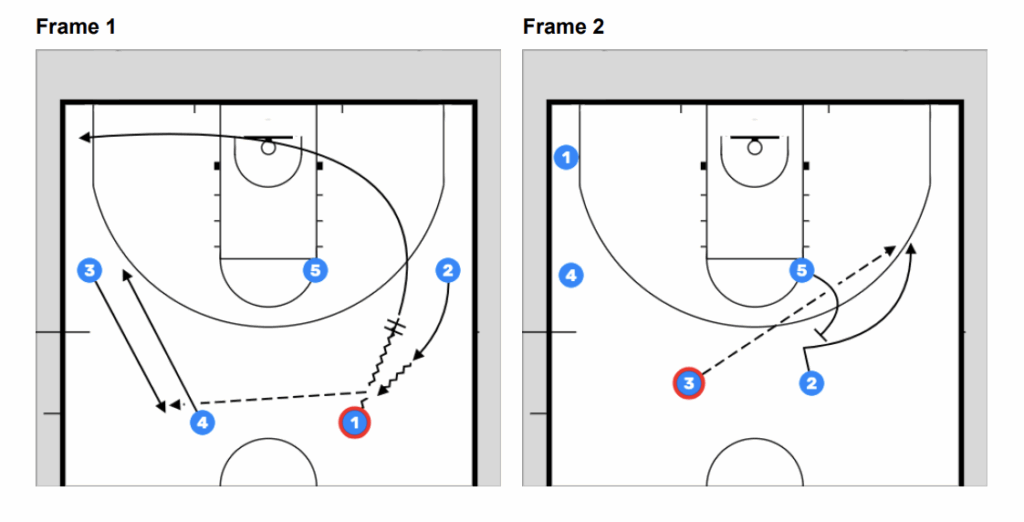
Chin Flare begins with the Forwards Out movement, with one adjustment: after delivering the dribble handoff, Player 1 cuts to the opposite corner, clearing out that side of the court.
Player 2 passes to Player 3, then receives a flare screen from Player 5. Below are examples of UConn running this set to create a scoring opportunity for Paige Bueckers, now a WNBA star with the Dallas Wings.
Princeton Offense: Chin Ricky
One final Chin set play UConn often uses is Chin “Ricky” (Fig. 5). The term “Ricky” is code for a rescreen.
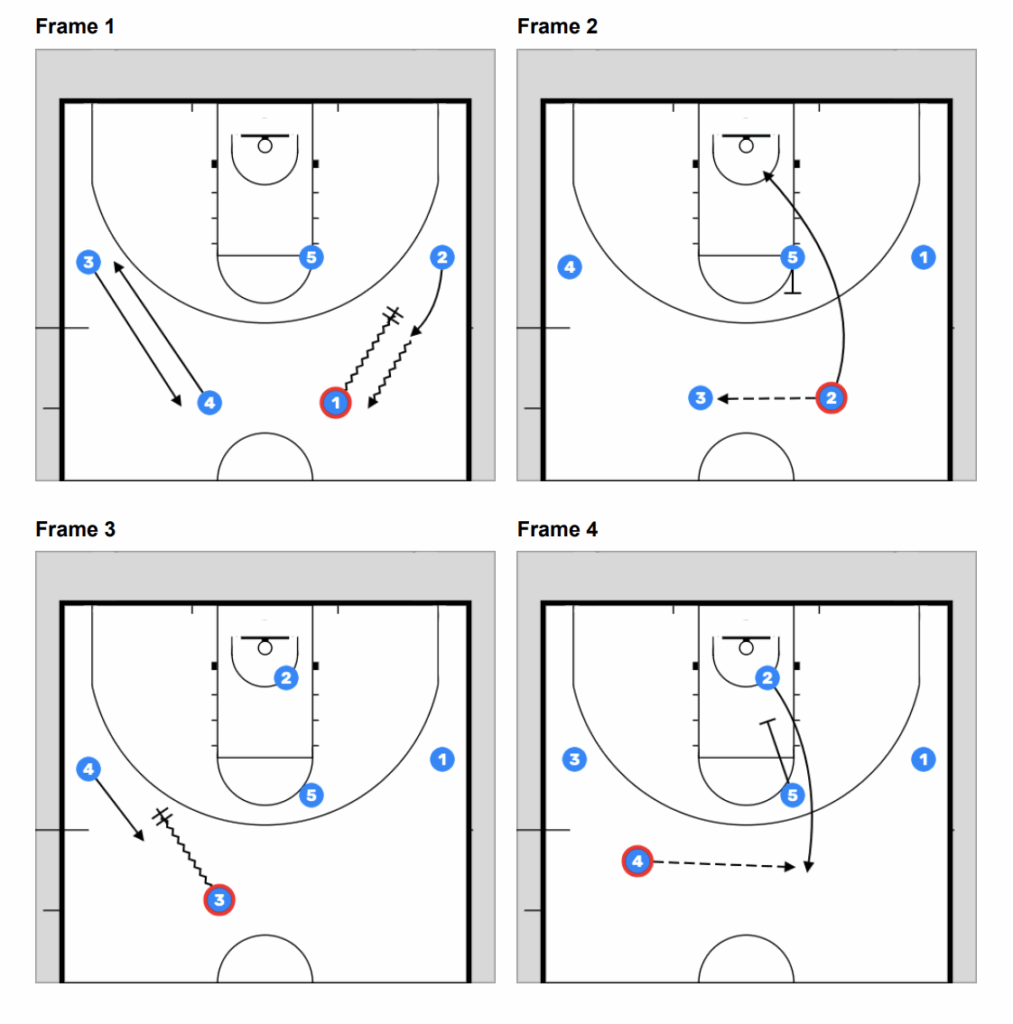
The action in Chin Ricky is much the same as in the basic Chin Set. It begins with a dribble handoff and an exchange (Forwards Out). In Frame 2, Player 2 makes a guard-to-guard pass, then cuts off the back screen set by Player 5.
In “Ricky,” Player 2 “hides out” in the paint while Player 3 executes a dribble handoff with Player 4. Meanwhile, Player 5 sets a down screen for Player 2. This is the rescreen.
Player 4 looks for Player 2 coming off the rescreen for a shot.
Conclusion
UConn’s use of the Princeton Offense shows how a team can build an effective half-court attack around a few core actions. The basic Chin Set creates opportunities through back screens, drift screens and repeated movement. Chin Flare and Chin Ricky take those same principles and turn them into set plays designed to create specific scoring opportunities.
The value is in the execution. UConn doesn’t need to reinvent the offense to create different looks. By running Chin with precision and adding variations at the right moments, the Huskies make a familiar system difficult to defend. It’s a good example of how sound offensive principles, executed well, can produce an efficient and versatile attack.
More Resources
- Princeton Offense Playlist – 56 videos breaking down the Princeton Offense!
- Princeton Offense Playbook Trio – Three Playbook Bundle
- Chin Clinic
- Guidance: Join our RAMP Program where we have helped numerous coaches bring Princeton Offense concepts to their programs!