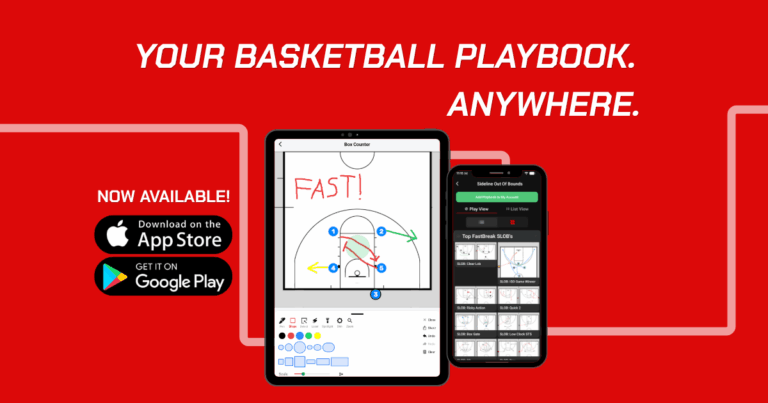
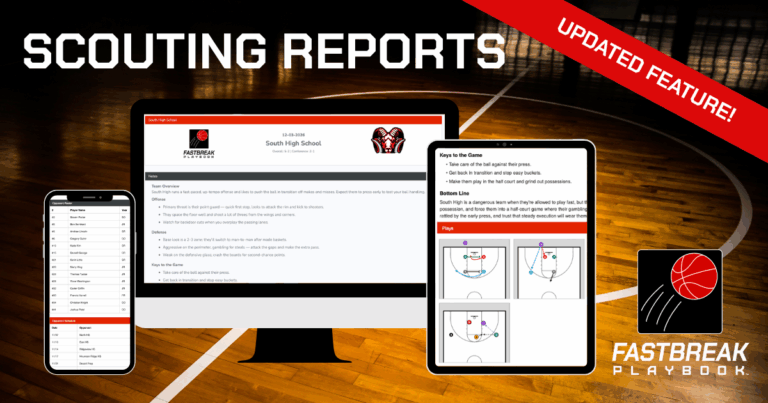
Most coaches know their plays. The problem shows up when players don’t share the same vocabulary. Even a well-designed system falls apart on the floor if everyone is using different words for the same actions. Basketball terminology playbooks fix that by giving your whole program a common language for cuts, screens, actions, and formations. When everyone calls things the same way, teaching gets faster, corrections stick, and players stop guessing what to do next. That is exactly what FastBreak PlayBook is built to support.
1. Types of Cuts: Build Off-Ball Movement With Purpose
Cuts drive every offense. Without a shared vocabulary, players tend to fill space rather than move with purpose. A basket cut attacks the rim hard right after a pass. A backdoor cut punishes an overplaying defender by reversing toward the basket. A V-cut creates separation on the perimeter so the ball handler has a clean look. Once your players know these names, they start recognizing the right moment for each cut. They stop waiting to be told what to do. Instead, they read the defense and react on their own. That shift in decision-making is one of the biggest jumps a young team can make.
2. Types of Actions: Give Every Play a Name
Actions are the building blocks inside every play. For example, a Flex Screen combines a baseline screen with a cross screen to free a cutter for a layup. A Floppy Action gives a shooter two screen options, so the defense cannot easily take away the look. A Screen the Screener Action frees the first screener after they set theirs. When players know the action by name, they understand their read before the ball even moves. That same idea is behind how smart frames basketball plays break down each movement step by step. Both approaches point toward the same outcome: players who execute because they understand the play, not just because they were told to run it.

3. Types of Screens: Teach the Purpose, Not Just the Mechanics
Screening is one of the most undercoached skills at the youth and high school level. A lot of the time, that comes down to players learning the physical motion without ever understanding the reason behind it. A Pin Down Screen frees a shooter who cuts from the low block up to the wing. A Back Screen sends a cutter toward the basket by screening away from the ball. A Down Screen pops a guard or wing out to the three-point line. When players can identify each screen by name, they understand the purpose behind the action and not just the footwork. That understanding is what separates a screen that creates an open shot from one the defense ignores entirely.

4. Formations: Start Every Play in the Right Spot
Formations set the table for everything else. Before any action begins, your players need to know where to stand and why. A 5-Out puts everyone on the perimeter to create driving lanes. A 4-Out 1-In keeps a post player near the rim as both a scoring and screening threat. A high-post alignment spaces the floor while keeping a decision-maker near the elbow. When formations are part of your basketball terminology playbooks, players show up in the right spots before the first pass is made. That saves a lot of repetition in practice. If you also track opponents during the season, consider how shared play tracking can extend that same vocabulary into your scouting process.
Why a Shared Language Makes Your Program Better
The goal of basketball terminology playbooks is not to add complexity. It is to take it away. When every player hears the same words and pictures the same actions, you spend less time clarifying and more time running good reps. High school and youth programs benefit the most from this because practice time is short and every rep counts. The vocabulary also only works if your whole staff uses it the same way. Build your terminology playbooks inside FastBreak PlayBook and give every coach on your staff a single reference for how your program teaches the game. When that foundation is in place, your players show up ready to work.