Basketball, like fashion, music and art, experiences trends. As coaches, we can all remember styles of play that have come and gone. Some trends have staying power, while others turn out to be fads.
One trend I’ve been watching is the spread of the Flow Offense. I first noticed it in international basketball, then saw it emerge in the NBA. Now, I’m seeing it adopted at other levels of the game.
The Flow Offense has three phases, each an independent attempt to create an advantage and score. Coaches can add layers to the system, but the basic Flow Offense combines these phases into a sequence of actions built around three different ball screen shapes using multiple sides of the floor.
Flow Offense Basics
The offense begins in five-out spacing out of transition. The opening action, or first phase, is the drag ball screen. Player 5 sets the screen for Player 1 and either pops or rolls, as shown.
It is important to approach the Flow Offense with an attacking mindset. The goal is to score off the Phase One drag screen. That opportunity may not always be there, of course. More often, the ball is passed out to Player 4 (Frame 1).
Free Trial: Get access to FastBreak Playbook
Player 4 then passes to Player 3, who is rising from the corner. This action could also be a dribble handoff. Either way, it transitions the offense into the second phase.
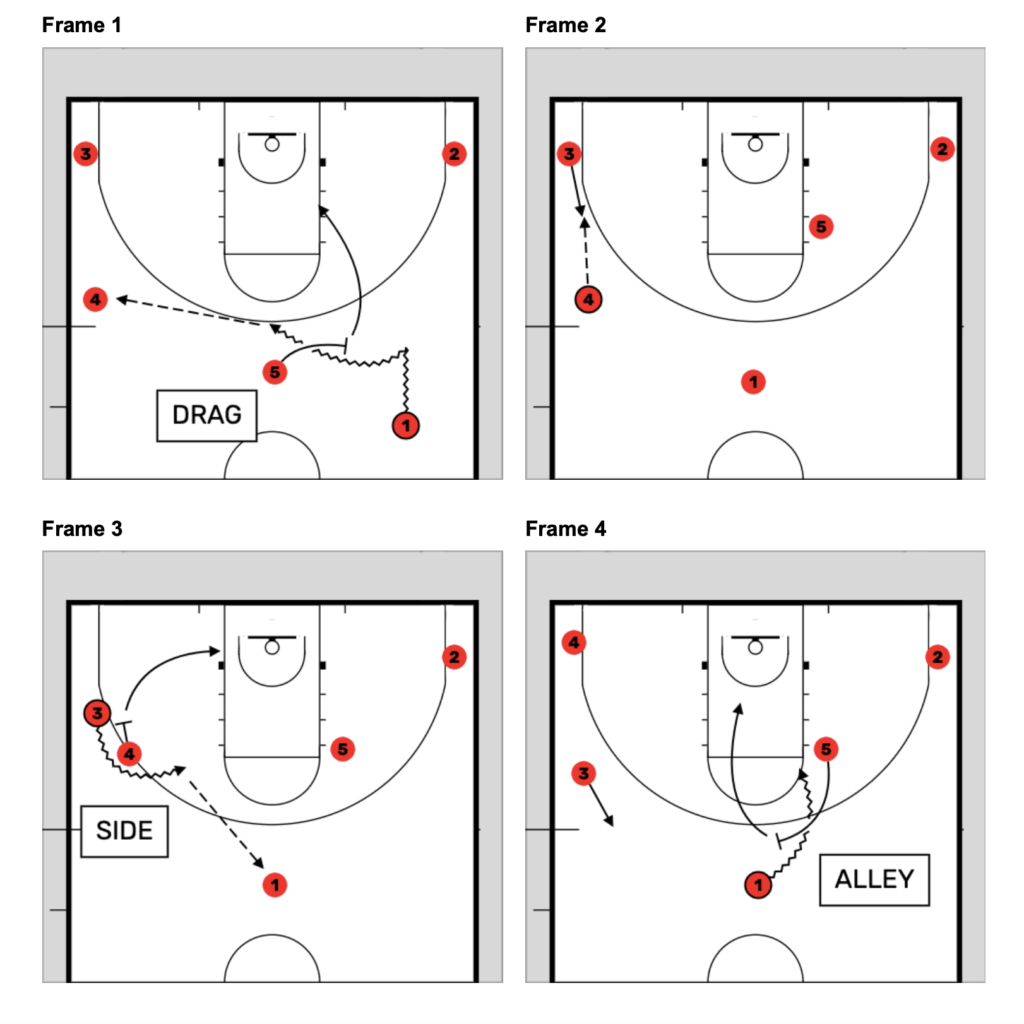
Player 4 follows their pass into a side ball screen for Player 3. This is the second phase of the Flow Offense sequence. (Frame 3)
Player 3 can reject the screen or use it, as shown. Player 4 can either roll or pop to the corner.
Note the positioning of the three players away from the side ball screen:
- Player 1 is at the midline of the court, well behind the 3-point line.
- Player 5, after rolling without receiving the ball, stays in the “pinch post” area near the elbow.
- Player 2 remains in the corner.
If the side ball screen does not produce a shot, the offense flows into the third phase with the pass out in Frame 4, leading to the alley ball screen.
As Player 1 receives the pass, Player 5 steps up from the pinch post area to set the alley ball screen. Player 5 aims for the “back pocket” of the on-ball defender and may pop or roll. If Player 5 rolls, Player 3 replaces behind the roll.
This is the basic Flow sequence: a drag ball screen out of five-out spacing leads into a side ball screen, which connects to an alley ball screen. If one action does not create a scoring opportunity, the offense flows directly into the next.
Flow Offense: Pinch Post Option
Every good offense needs built-in counters to address defensive adjustments and disruptions. In the Flow Offense, using the pinch post is one such option.
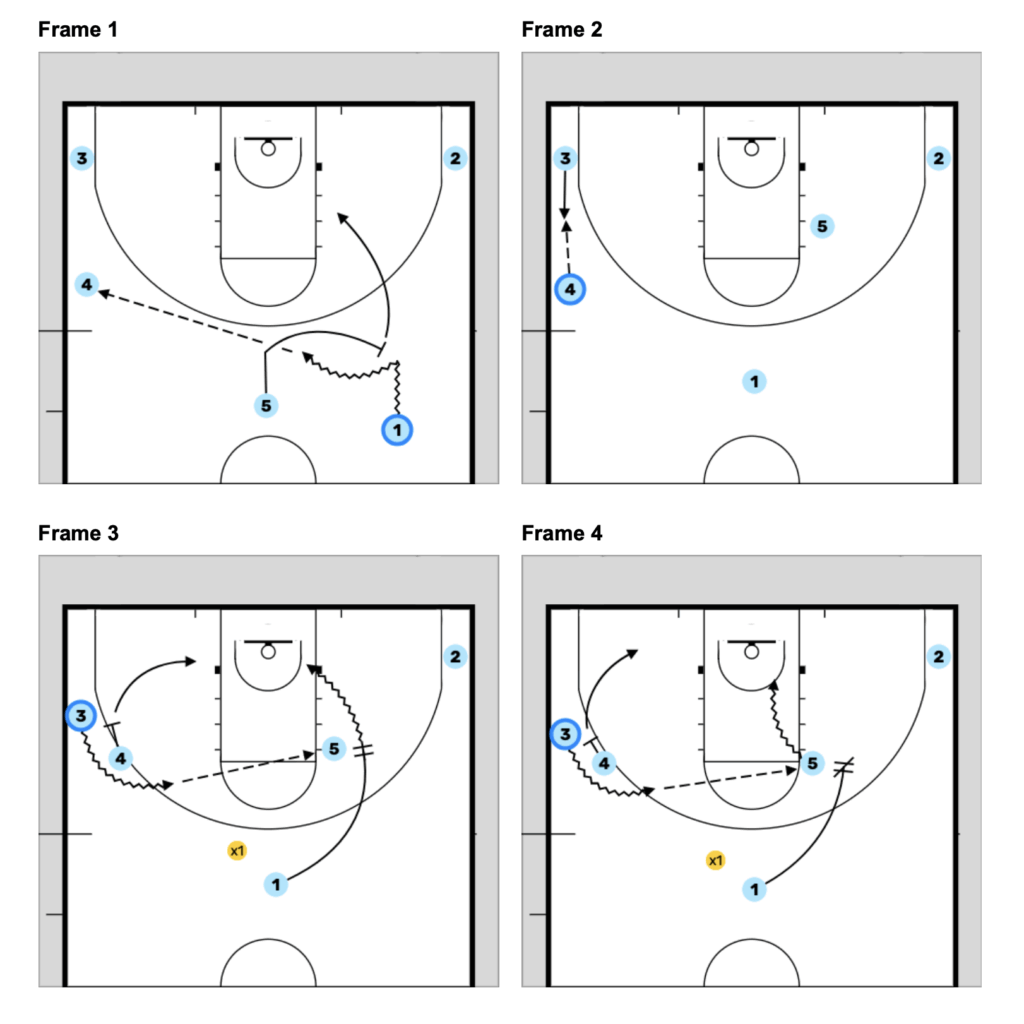
Frames 1 and 2 show the same basic sequence through the first two phases of the offense. The drag ball screen out of the spread formation flows directly into the side ball screen.
The defensive disruption occurs in Frame 3, where a defender (X1) denies the pass to Player 1. To counter, Player 3 passes to Player 5 in the pinch post area. Player 1 now has a positional advantage and can cut downhill to receive a handoff from Player 5. If the defense disrupts the handoff, Player 5 can fake the exchange, keep the ball and attack the basket.
Conclusion
The Flow Offense is built around continuous movement and the ability to create advantages through a sequence of ball screens. Each phase presents a scoring opportunity, and the next action is ready when the defense takes away the first one. The pinch post option adds another layer, giving the offense a way to respond when defenders disrupt the normal flow.
As more teams adopt this approach, understanding the structure and purpose of each phase becomes increasingly valuable. The strength of Flow lies in its ability to keep the defense reacting while the offense continues to attack.
More Resources
- Video: Tuomas Iisalo Flow Offense Clinic
- Join RAMP where we are helping coaches run these concepts with their teams!