Why are experienced college basketball coaches having so much trouble getting their players to communicate?
Listen to enough college basketball postgame press conferences this season and you’ll start hearing a familiar complaint.
The season is early, but coaches are frustrated with their team’s communication. They’re talking about players failing to call out screens, recognize defensive assignments, communicate rotations and help teammates understand what’s happening on the floor.
These aren’t first-year head coaches trying to figure out how to get their message across. We’re hearing it from experienced coaches who have spent decades teaching the game. They understand what good basketball looks like, and they’re seeing something missing from their teams.
Why are experienced college basketball coaches having so much trouble getting their players to communicate?
It’s an interesting question because communication touches almost every part of the game. A team can have a sound defensive scheme, a good understanding of its opponent and players who know their individual assignments. When those players fail to communicate, the entire system starts to break down.
There are a few things worth considering.
Communication is a basketball skill
We spend considerable time teaching players how to shoot, pass, handle the ball and execute offensive actions. Coaches devote entire practice segments to defensive positioning, ball-screen coverages and transition responsibilities.
How much time goes toward teaching players how to communicate?
Players need to recognize what’s happening on the floor and understand what information their teammates need. Defenders guarding the ball screen need to communicate the action early enough for their teammates to respond. A player on the weak side needs to recognize the developing rotation and provide information that helps the defense stay organized.
Those are basketball skills. They require knowledge, timing and practice.
Telling players to talk during practice establishes an expectation. Teaching them what to say, when to say it and why it matters requires more deliberate coaching.
Communication starts with clarity
Consider a team struggling to communicate defensively. A coach might hear silence during ball-screen coverage, late calls during switches or confusion when an opponent moves the ball from one side of the floor to the other.
Those problems often begin with a lack of clarity.
Does every player understand his responsibility in the coverage? Does the team have a shared understanding of who calls the screen and who communicates the rotation? Can players recognize the situations that require an adjustment?
A player who understands his assignment can communicate with confidence. He recognizes the action and knows what information his teammates need.
Coaches should establish clear communication responsibilities within their defensive system. Every player needs to understand his role and the language associated with it. That includes the player guarding the ball, the player providing help and the teammates positioned away from the action.
Clarity gives players something specific to communicate.
Communication needs repetition
Communication improves through practice. Players need opportunities to recognize situations, make decisions and talk through their responsibilities while the game continues around them.
Coaches can build this into their everyday practice plans.
During shell drills, require players to communicate the ball movement, cutters, help responsibilities and defensive rotations. In transition drills, establish clear expectations for stopping the ball, locating opponents and organizing the defense. During competitive segments, track communication as part of the team’s execution.
The coaching staff should also pay attention to the quality of the communication. A loud call that comes too late has limited value. Players need to deliver useful information at the right moment.
Repetition helps players develop the habit. Eventually, the language becomes part of how the team operates.
Communication requires accountability
Every coach has heard a player go silent during a defensive possession. The screen arrives, a teammate gets caught in the action and nobody provides the information needed to help.
What happens next?
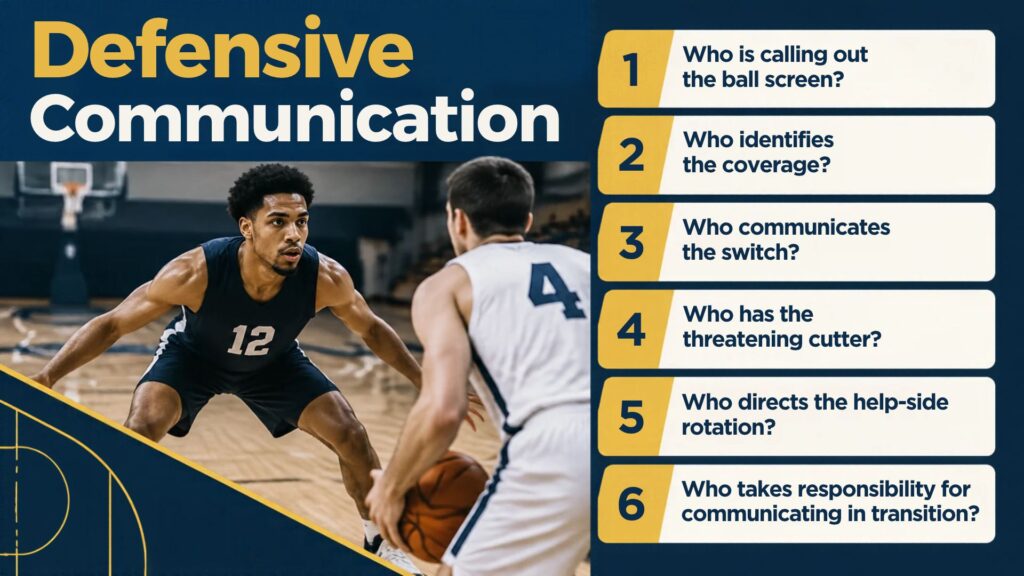
If communication is a team standard, coaches have to hold players accountable for meeting it. That means correcting missed calls during practice and recognizing players who consistently help their teammates through communication.
Coaches can also build communication into their practice evaluations. Which players consistently organize the defense? Who recognizes an opponent’s action early? Who helps teammates understand their responsibilities when a possession becomes disorganized?
These behaviors deserve attention.
Accountability also applies to the coaching staff. Players need consistent terminology and expectations from the people teaching them. When coaches change language from one practice to another, players have a harder time developing a common vocabulary.
A team develops communication habits through the standards its coaches reinforce every day.
Today’s teams have to develop a common language
College basketball presents another challenge. Coaches work with rosters that bring together freshmen, transfers and players from different programs. Each player arrives with a different basketball background and experience with defensive terminology.
Free Trial: Get access to FastBreak Playbook
One player might have spent two years playing a particular ball-screen coverage. Another might have learned an entirely different approach. A freshman might understand the terminology but have limited experience communicating within a college-level defensive system.
Coaches have to bring those players together.
They need to establish the language of the team and give players opportunities to use it. This takes time, especially early in the season when players are still learning one another’s tendencies.
The coaching staff should pay attention to how well players communicate as they install their systems. That information can reveal whether players understand the scheme, recognize their responsibilities and trust their teammates enough to speak up.
Communication becomes part of the team’s identity through that daily work.
Is technology to blame?
There is another explanation that comes up frequently in conversations about today’s players. Technology gets a lot of the blame. Coaches point to cell phones, social media and the amount of time young people spend looking at screens. They question whether players have lost the ability to communicate face-to-face or develop meaningful connections with one another.
There may be some truth to those concerns. Technology has changed the way young people interact, and coaches are working with players who have grown up in a different communication environment. That is part of the landscape of coaching today.
Coaches have been blaming technology for the shortcomings of young people for generations. Television was going to change the way kids thought and behaved. Video games became a concern. Then came the internet, cell phones and social media. Every generation seems to find a new technology to explain why young people are different.
At some point, coaches have to accept the environment in which they coach. Players arrive with habits shaped by their experiences. The coaching staff has to work with those players and develop the skills the team needs.
If players struggle to communicate, that becomes a teaching responsibility. Coaches can establish expectations, teach players what effective communication looks like and build those behaviors into daily practice. The influence of technology might help explain some of the challenges. The work of developing better players still belongs to the coaching staff.
Everybody Is Talking About Talking
The early-season comments from veteran coaches provide a useful reminder for anyone involved in coaching basketball.
Communication deserves the same attention as the other skills that determine how a team plays. Coaches have to establish clear expectations, create opportunities for repetition and hold players accountable for doing their jobs. Every generation of coaches has a new technology to blame. Every generation of coaches still has to teach.
At Radius Athletics, we use the CRA Framework: Clarity, Repetition and Accountability. Communication provides a practical example of how those three coaching responsibilities work together.
A team needs to know what to communicate. Players need to practice communicating in game situations. Coaches need to reinforce the standard until it becomes part of the team’s daily habits.
The next time a coach walks into a press conference frustrated by his team’s lack of communication, there’s an important question worth asking: What has the coaching staff done during practice to teach it?
More Resources
- The Coaching Essentialism Handbook
- Coaching Clarity: A weekly journal for focused leaders
- Join RAMP where through our CRA Framework we help coaches improve communication