How push-pull movement creates driving space and puts help defenders under pressure.
Every coach wants an offense that generates frequent paint touches. They can come in several ways, but the simplest is dribble penetration.
Attacking the paint off the dribble puts the defense under stress, forces help and rotations, and often creates efficient shots at the rim or open 3-pointers off the drive-and-kick. Entire offenses have been built around little more than dribble penetration and the scoring opportunities it creates.
Maximizing dribble penetration also requires the involvement of players without the ball. Where should they cut when a teammate drives to the basket? Should they cut at all? How can they manipulate space and disrupt the defense with their movement? These reactions are often the missing piece. Without defined reactions to dribble penetration, an offense can waste the advantages created by the drive.
Push-Pull Movement
When offensive players are stationary, defenders can easily identify their assignments and determine where help should come from. Think of shell drill, where the low defender is responsible for helping on a baseline drive.
Free Trial: Get access to FastBreak Playbook
Putting the non-driving players in motion as the ball is driven, however, makes defensive responsibilities less clear. One example is push-pull movement.
In push-pull movement, dribble penetration pushes some offensive players away from the ball while pulling others.
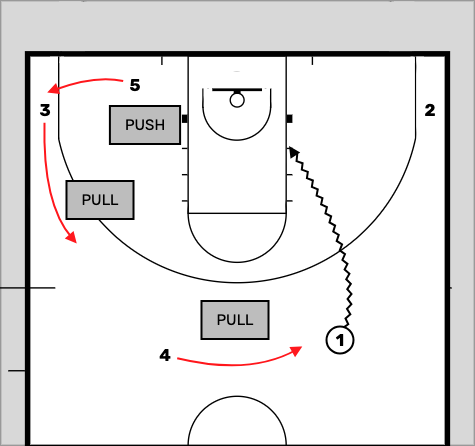
In the diagram above, Player 1 attacks with a lane drive. Push-pull movement pushes Player 5 away from the ball, pulls Player 3 out of the corner and brings Player 4 into the driver’s “taillights.” Potential help defenders are now caught between helping on the drive and staying attached to their moving assignments.
Off-ball players are cutting, but their movement doesn’t interfere with the drive. In fact, the cuts create more space for the driver. As defenders react to the movement, help assignments can become unclear.
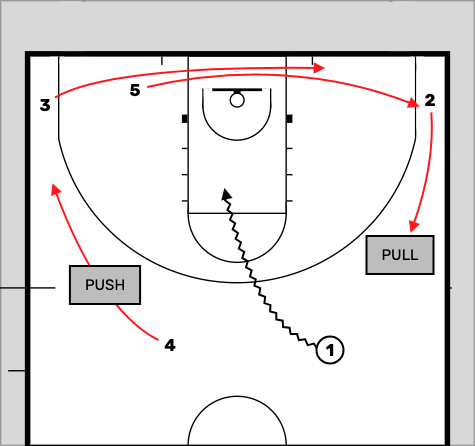
Above, Player 1 attacks with a middle drive. Player 4 pushes away from the ball, creating space and forcing their defender to choose between helping on the drive and staying with their assignment. Player 2 pulls behind the drive, while Players 3 and 5 push along the baseline.
In the baseline drive example (Fig. 3), as Player 2 drives, Player 5 pushes while the remaining players pull around the arc.
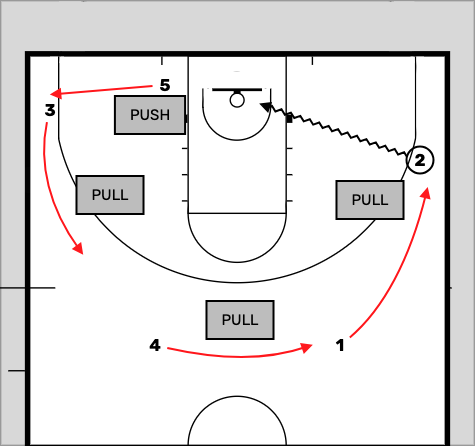
A simple teaching cue for push-pull movement is: “Drive right, move right” or “Drive left, move left.” Look at the three diagrams above and notice how the off-ball players move in the same direction as the driver.
You may also hear this concept referred to as “circle” or “wheel” movement, both apt descriptions of the action.
Conclusion
Push-pull movement gives the driver a clear picture of how teammates will move as the ball enters the paint. That familiarity allows the driver to attack with confidence, knowing where space will open and where teammates will move. The cuts create driving lanes, pull help defenders away from the basket and force defenders to make decisions on the move. As those defenders adjust, their help responsibilities can become unclear, creating opportunities for the offense to capitalize. When players understand how to move together around dribble penetration, the driver gains space and the entire offense becomes harder to defend.
More Resources
- Join our RAMP Program where we have helped numerous coaches implement these concepts!
- Diagrams: Dribble Penetration Reactions