Few trends in basketball are more popular than 5-out offense. It is considered cutting-edge, modern and “positionless.” It may be all of those things, but it is not new.
Mike D’Antoni could be considered one of the forefathers of 5-Out offense. That portion of his playbook is often labeled “Delay,” and those options are what we’ll explore here.
Delay: Same Side
Delay begins with a pass to the center in the middle third of the court. The action can be run out of a 21 Series or a traditional 5-out alignment.
In the first two options, the action stays on the same side of the floor as the initial pass.
Click the image below to view the diagrams.
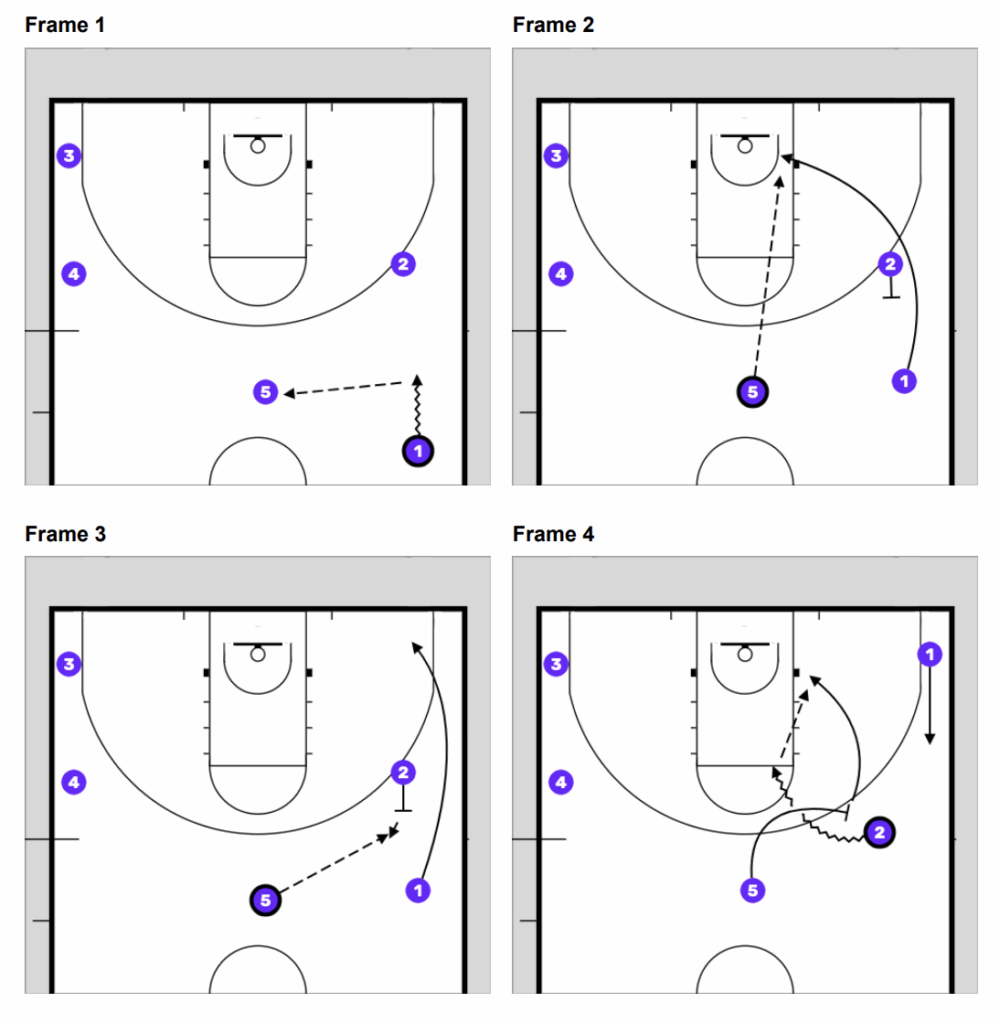
Delay Step (Fig. 1) can be part of the 21 Series package. Instead of throwing ahead to Player 2, the point guard passes to Player 5 in the middle third of the court. This triggers the Delay options.
Player 1 then sprints off a step-up back screen from Player 2, creating an opportunity for Player 5 to hit Player 1 on a curl to the basket.
If Player 1 is not available, Player 5 passes to Player 2 and follows the pass into a spread ball screen. Player 1, now behind the screen, lifts from the corner as Player 5 rolls to the basket.
Free Trial: Get access to FastBreak Playbook
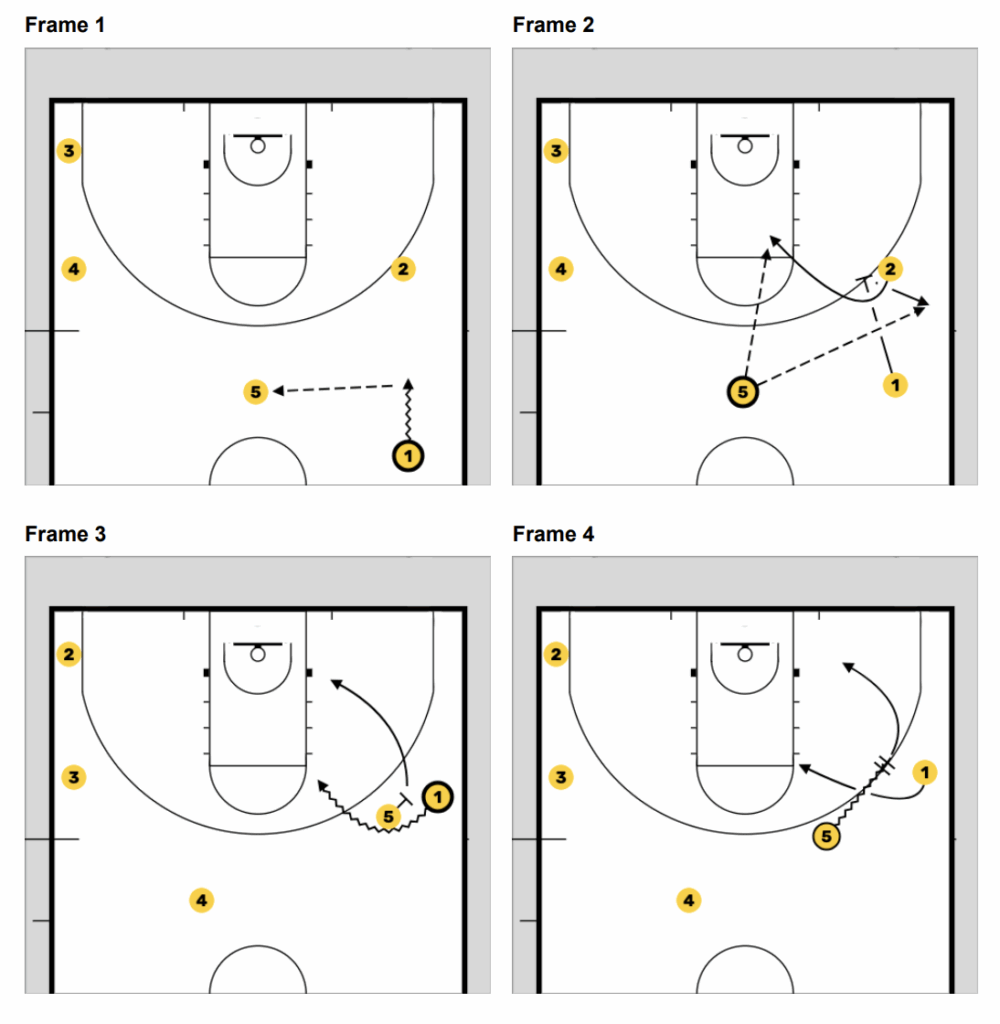
Delay Inside (Fig. 2) is another same-side action out of the 21 Series. Once again, the pass to the center in the middle of the floor initiates the Delay options.
In Frame 2, Player 1 cuts just inside Player 2 to set a rub screen. Player 2 loops around Player 1, creating an opportunity for Player 5 to hit Player 2 on a curl to the basket.
The action presents two threats: one player cutting toward the rim and another popping out beyond the 3-point line.
In Frame 3, Player 5 passes to Player 1, who pops to the perimeter after setting the rub screen. Player 5 then follows the pass into a side ball screen. Alternatively, Player 5 can execute a dribble handoff to Player 1 (Frame 4).
Delay: Weak Side
In the next set of Delay options, the action shifts to the weak side. After passing to Player 5 in the middle third of the court, the offense flows to the second side.
Delay Weak moves the ball from side to side, involves more players in the offense and reduces the offense’s reliance on ball screens for the point guard.
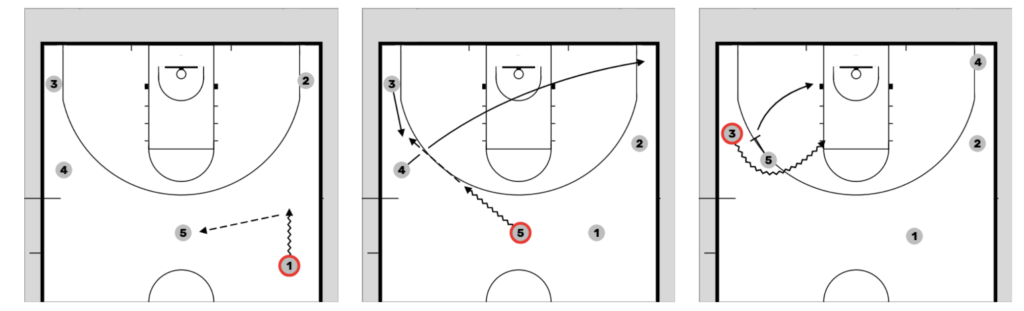
Frame 1 (Fig. 3) shows the pass to Player 5 in the middle third of the court. In Frame 2, Player 5 dribbles to the weak side. Player 4 cuts backdoor, then continues to the far corner if the backdoor pass off the dribble-at action is not available.
Player 3 lifts from the corner as Player 5 passes ahead and follows the pass into a side ball screen.
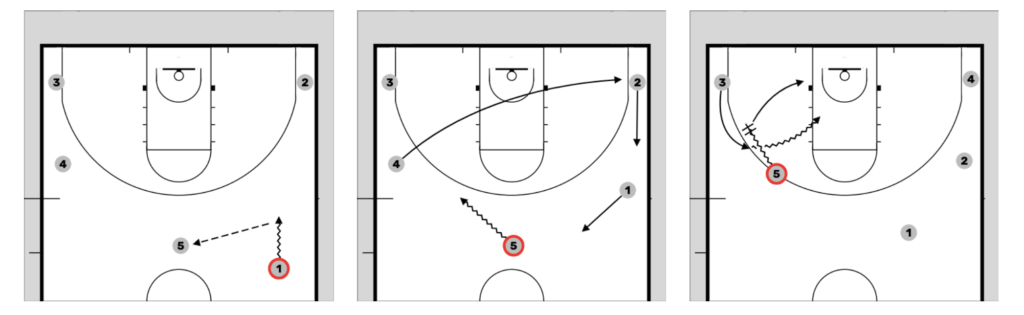
Another option out of Delay Weak is a simple dribble handoff (DHO). The action remains the same through Frames 1 and 2. Instead of passing ahead and following into a side ball screen, Player 5 delivers a dribble handoff to Player 3, who lifts from the corner (Fig. 4).
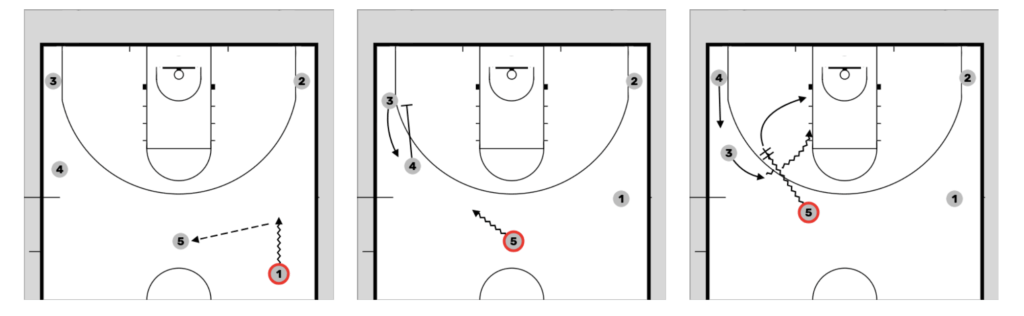
Our final Delay Weak action features the Zoom concept, which combines a down screen with a handoff. The offense screens for the handoff recipient, forcing the defense to navigate two actions in quick succession (Fig. 5).
As Player 5 turns toward the weak side, Player 4 sets a down screen for Player 3. Player 5 then delivers the handoff to Player 3.
After the handoff, Player 5 makes contact with Player 3’s defender before rolling to the basket. Player 4, now behind the action, lifts as Player 5 rolls.
Conclusion
The popularity of 5-out offense may be a modern trend, but the concepts behind it are not new. The D’Antoni System offers a blueprint for how to create advantages through spacing, movement and a series of connected actions.
Whether running Delay options on the same side or shifting the action to the weak side, the goal remains the same: keep the defense moving, involve multiple players and create opportunities to attack. These options are a reminder that effective offense is not always about inventing something new. Sometimes, it’s about understanding how to use proven concepts.
More Resources
- Video Playlist: The D’Antoni System
- Part One: The D’Antoni System: Drag Ball Screens
- Part Two: The D’Antoni System: 21 Series
- Part Three: The D’Antoni System: Set Plays
- Guidance: Join our RAMP Program and get experienced guidance on this system