The D’Antoni System is more than transition offense and drag screens. It also features an early offense package built for quick-hitting variety and adaptability.
21 Series is an early offense package that requires just one call but can branch in different directions based on how the possession develops. Used by coaches at all levels, 21 Series combines two- and three-player actions that teams can execute early in the possession.
The package offers several options, but its three core actions are Chase, Keep and Step. Let’s break them down.
21 Series: Chase
The basic setup for 21 Series is as follows:
- Wing in one corner
- Forward up the sideline from the wing
- Center at the midpoint between the top of the circle and the half-court line
- Wing “button-hooked” astride the 3-point line, facing the half-court line at or near the free-throw-line extended
- Point guard advancing the ball with the dribble
- Click on images in this article to get diagrams!
You can see the setup in Frame 1 of Fig. 1 below:
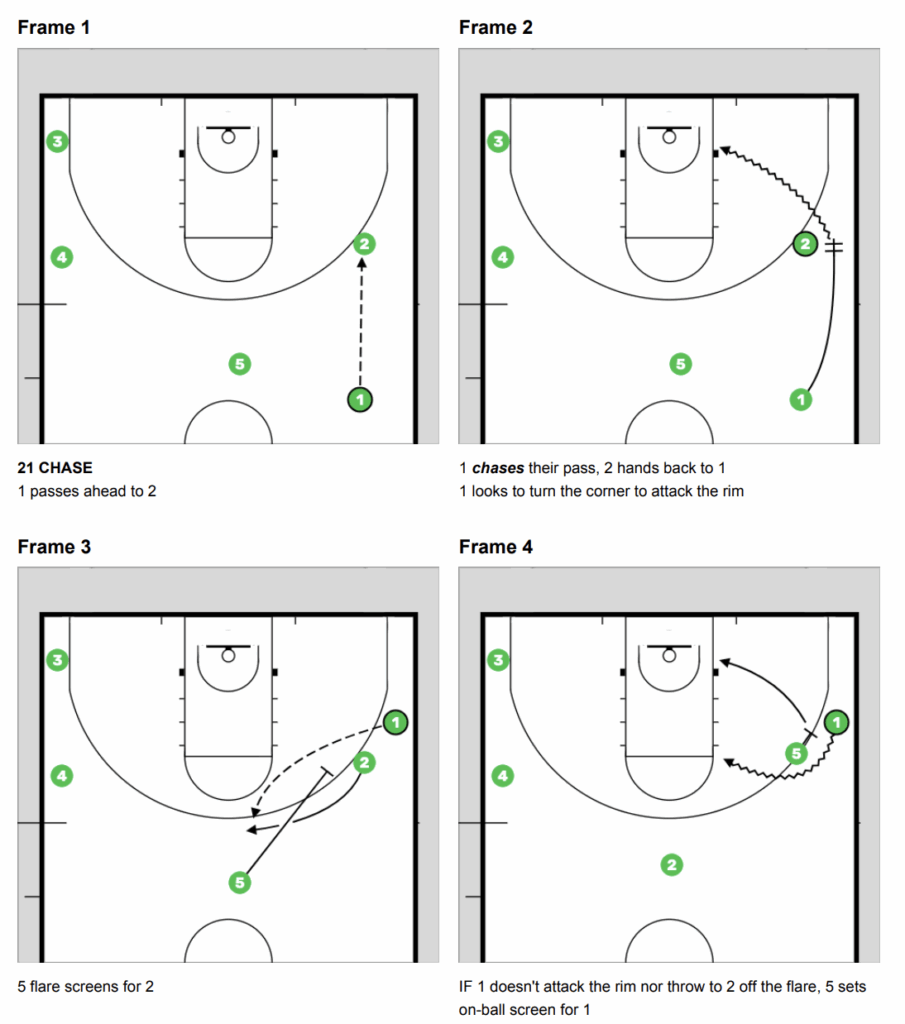
The signature feature of the Chase option is Player 1 passing ahead to Player 2, then chasing the pass for a handback. Player 1 should sprint to get the ball back as if trying to outrun the pass. This can create an opportunity for Player 1 to attack the rim (Frame 2).
After the handback, Player 2 receives a flare screen from Player 5. Many teams put their best shooter at the wing so that player receives the flare screen.
If Player 1 does not attack or pass to Player 2 coming off the flare screen, Player 1 receives a deep side ball screen from Player 5.
Free Trial: Get access to FastBreak Playbook
21 Series: Keep
In the next option, the setup is the same. Player 1 passes ahead and chases the pass. The difference is that Player 2 keeps the ball instead of handing it back to Player 1.
Player 2 determines whether the handoff is “clean” or “dirty.” A clean handoff leads to Chase. If the handoff is dirty or disrupted, Player 2 keeps the ball and Player 1 extends to the corner.
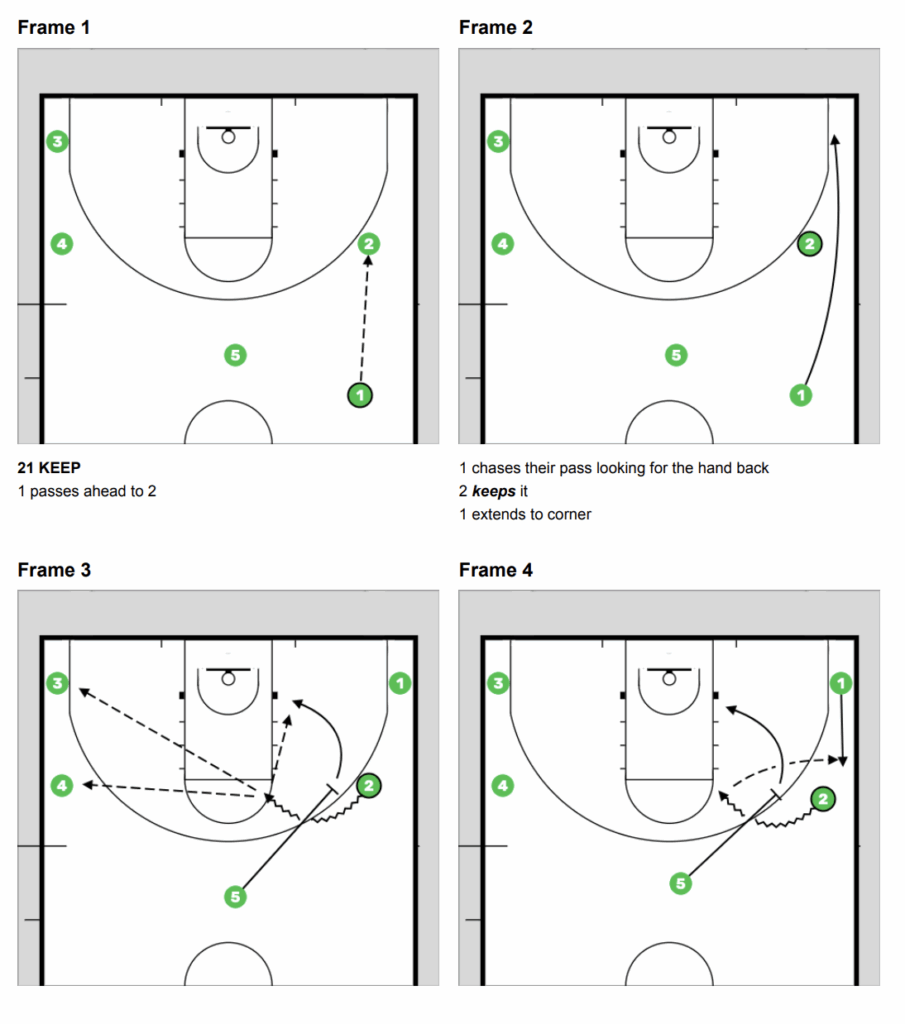
Player 5 then sets a ball screen for Player 2. This creates pick-and-roll, drive-and-kick and throwback options to Player 1 lifting from the corner.
21 Series: Step
In the previous options, Player 1 passes ahead to Player 2. In the final of the three basic 21 Series options, Player 1 keeps the dribble and receives a step-up ball screen from Player 2.
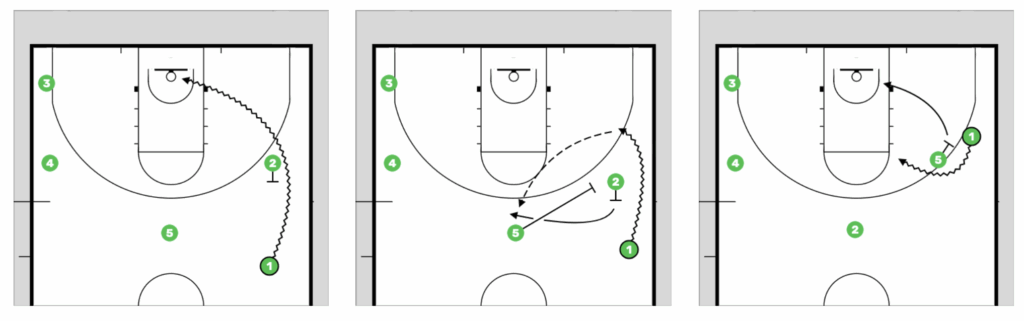
The step-up screen creates space and an empty corner for Player 1 to attack. If Player 1 does not attack the basket, Player 2 has the same flare screen option we saw in 21 Keep. This time, it becomes a screen-the-screener action.
Finally, if Player 1 does not attack or hit Player 2 coming off the flare screen, Player 5 continues into a deep side ball screen for Player 1.
21 Series: Implementation
Coaches can integrate 21 Series in different ways. Here are two approaches I used with our teams.
Free-Throw Break — We used 21 Series exclusively after opponent free-throw attempts. When an opponent went to the line, we called “21” and transitioned into the series whether the free throw was made or missed. After a defensive stop or an opponent made field goal, we ran the transition system discussed in Part One of this series.
No Specific Calls — As noted earlier, we called “21” rather than specifying “21 Keep,” for example. Players knew to sprint into the formation, but we left the decision to hand back, keep the ball or use the step-up screen to them. The action was determined by their reads and the defensive look.
21 Series: Conclusion
21 Series gives you a simple way to organize early offense without taking away the reads that make an offense difficult to guard. One call gets your players into the formation, and the action develops from there.
That was the value I found when we used it. Our players knew where to get into the formation and what options were available, but they also had the freedom to read the defense and play from those reads.
Chase, Keep and Step give you three starting points within the same framework. You can build the series around your personnel, your transition philosophy and the defensive looks you see most often.
The goal is simple: get into something early and make the defense guard quick-hitting actions.
More Resources
- Note: The videos in this piece features Marshall University who was coach by Dan D’Antoni, brother of Mike, at the time of production.
- Video Playlist: The D’Antoni System
- Playbook: 21 Series Playbook
- Part One: The D’Antoni System – Drag Ball Screens
- Guidance: Join our RAMP Program and get experienced guidance on this system