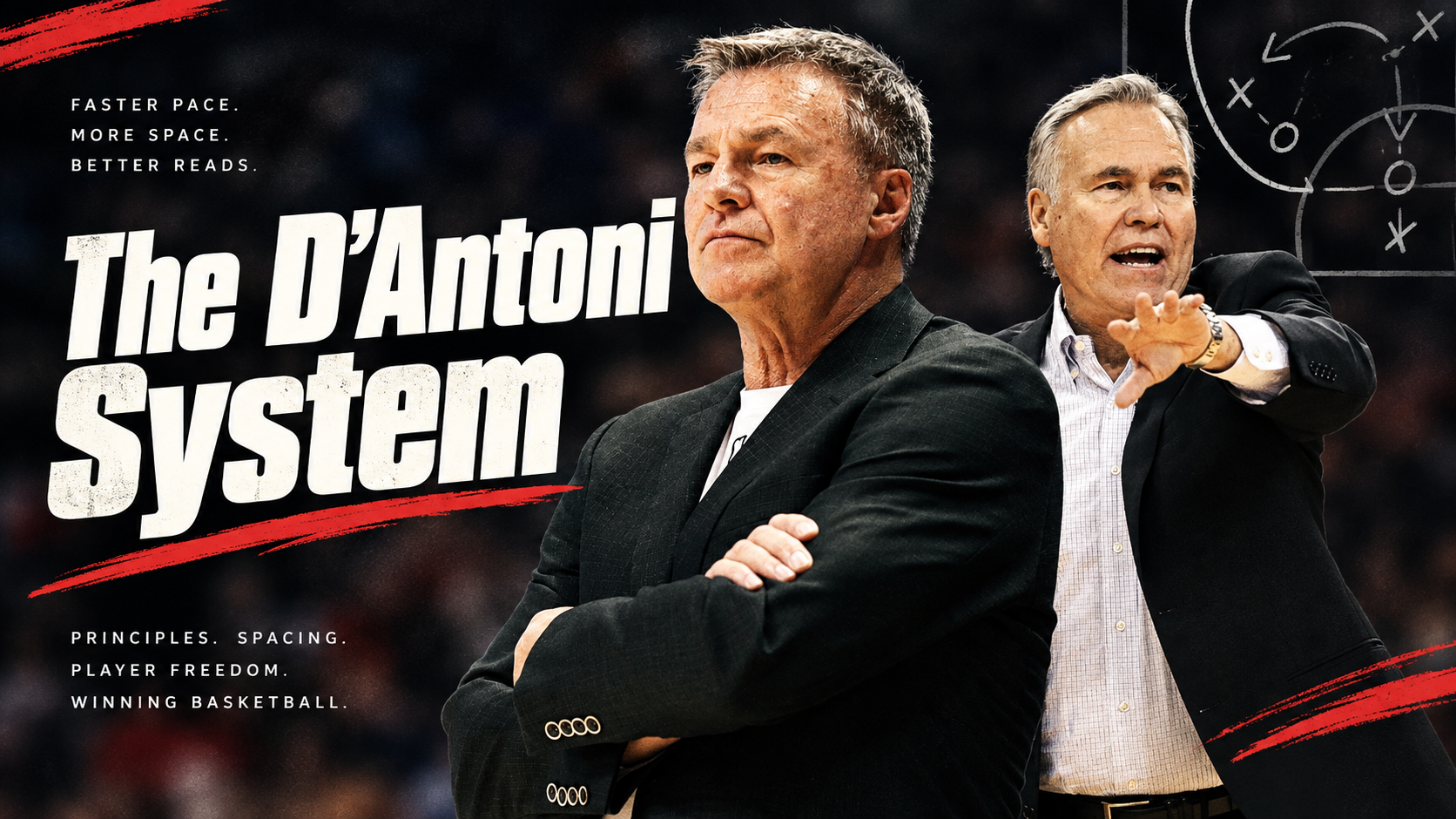
Few basketball coaches have reshaped the game as significantly as Mike D’Antoni. During his tenure as head coach of the Phoenix Suns from 2003 to 2008, D’Antoni introduced the “Seven Seconds or Less” attack, helping usher in the pace-and-space era. At the time, his system pushed the boundaries of conventional basketball strategy. Today, its foundational principles of pace, spacing and 3-point shooting are central to the modern game.
This is the first installment in a series breaking down the D’Antoni System. Drag ball screens are the cornerstone of the offense and the logical starting point for our analysis.
Transition Offense
Everything starts in transition. The D’Antoni System begins with the fast break and flows seamlessly into the drag ball screens discussed below.
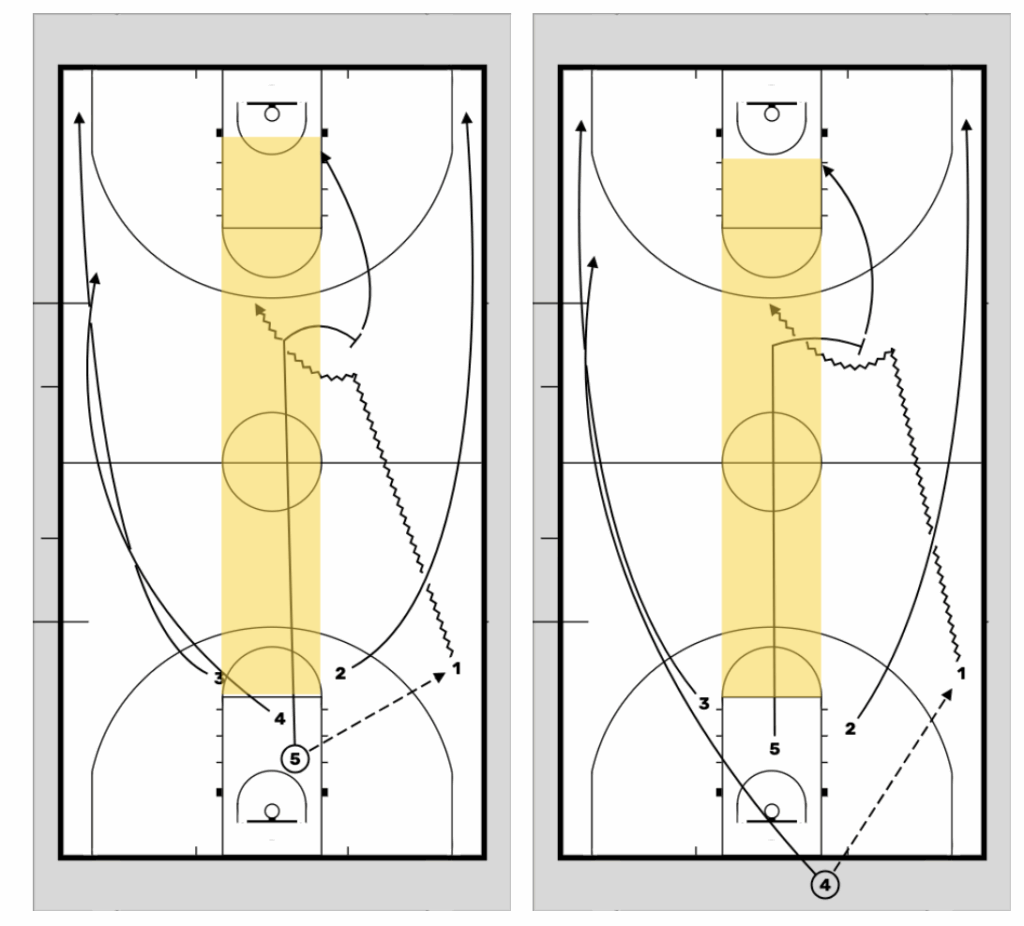
Whether coming after a defensive rebound (Frame 1 above) or an opponent’s made field goal (Frame 2 above), the goal is to establish the proper spacing and get into the offense quickly. Here are the key principles to execute in transition:
- Make a quick inbound pass or outlet toward the sideline.
- Have two players sprint wide and then deep to the corners.
- All players except the center should find a sideline.
- Main Street, the area highlighted in yellow above, belongs to the center.
Following these principles gets the offense into the half court with the proper spacing to flow directly into the basic drag ball screen.
The D’Antoni System: Basic Drag
The D’Antoni System uses several types of drag screens, but the basic drag is the most common.
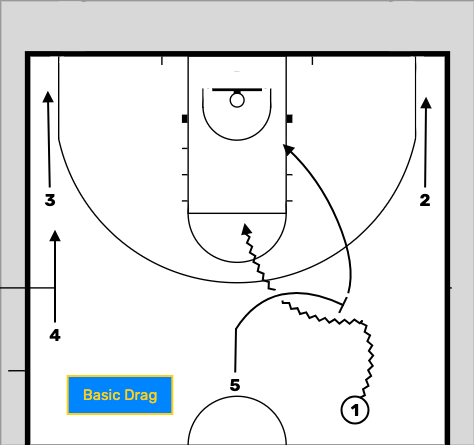
The basic drag flows directly out of the transition offense. If there is no fast-break opportunity, player 5 sets a ball screen for player 1 (Fig. 2 above).
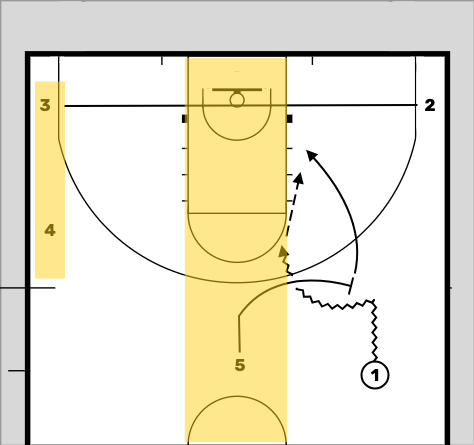
The basic drag is central to the D’Antoni System and deserves a closer look. This is where the “space” in “pace and space” comes into play. The spacing template in Fig. 3 above establishes the following principles:
- Players 2 and 3 occupy the corners at rim depth
- Player 4 occupies the high-wing position, just above the free-throw line extended.
- Players 3 and 4 hold the sideline, creating the “double side.”
- Player 5 moves out of Main Street to set the ball screen for player 1. The screening angle should force the defender to go over the screen.
- Overall goal: Create maximum width and spacing while keeping the interior open for the pick-and-roll.
Other Drag Types
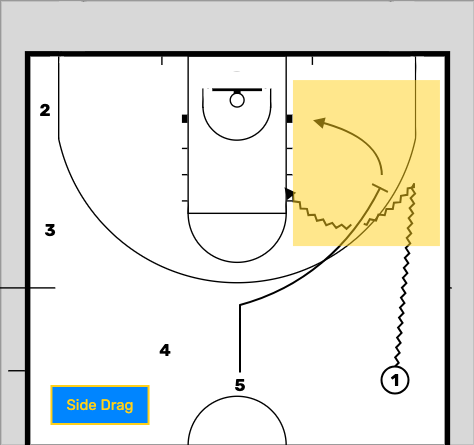
The basic drag is the primary screening action in the D’Antoni System, but the offense also uses other variations. At times, the transition alignment is unbalanced, with the ball advancing up one side of the floor. This naturally creates an opportunity for a side drag with an empty corner.
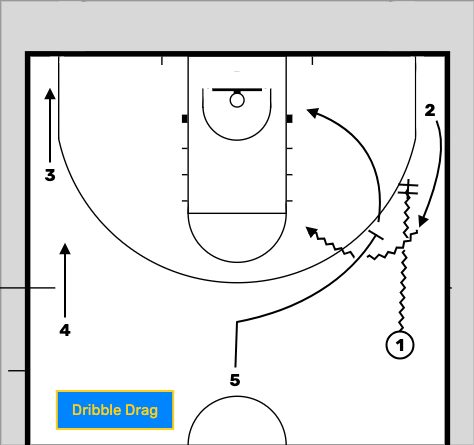
Another variation is the “dribble drag,” which begins with a dribble handoff. Player 1 advances the ball into the frontcourt and hands it off to player 2, who rises from the corner. Player 5 then sets a ball screen for player 2 as the handoff flows into the screening action (Fig. 5 below).
A related action to dribble drag is the dribble push into a side drag.
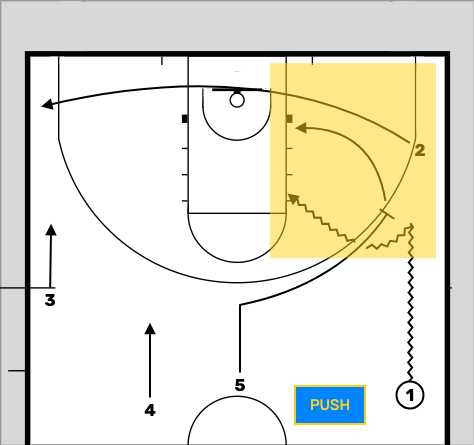
With the dribble push, player 1 dribbles toward player 2, triggering a backdoor cut. Player 2 cuts behind his defender and exits to the far corner, clearing the side for player 1 to attack the empty corner. If player 1 does not attack, player 5 leaves Main Street and sets a side ball screen for player 1.
Free Trial: Get access to FastBreak Playbook
The final drag type is the double drag. This action uses two ball screeners who set back-to-back screens for the ball handler.
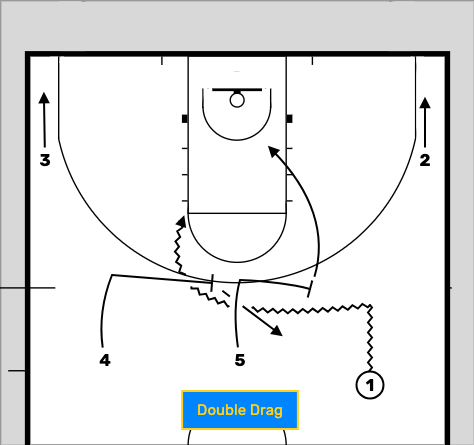
A common option is to have one screener roll while the other pops. The better shooter of the two screeners is often the natural choice to pop, as shown with player 4 in Fig. 7 above.
Conclusion
The D’Antoni System starts with a simple idea: play fast, create space and put the defense in difficult positions. Drag screens connect the transition game to the half-court offense and give the ball handler an immediate advantage. The different drag variations allow the offense to maintain those principles even when the transition alignment changes.
For coaches, the value is not simply in adding another ball screen action to the playbook. It is in teaching the spacing, pace and reads that make the action effective. The basic drag provides the foundation, while the variations give players solutions when the defense or transition alignment takes them away from the original action.
More Resources
- Note: Many of the videos in this piece feature Marshall University who was coach by Dan D’Antoni, brother of Mike, at the time of production.
- Video: Marshall Thundering Herd Video Playlist
- Playbook: Ball Screen Teaching Progression
- Diagrams: The D’Antoni System – Drag Types
- Guidance: Join our RAMP Program and get experienced guidance on this system